



CELEBRATING THE ARTS: Lake Area Ballet Theatre Announces New Season of Performances
September 2026
Muscle Activation’s Role in Reducing Pain
September 2026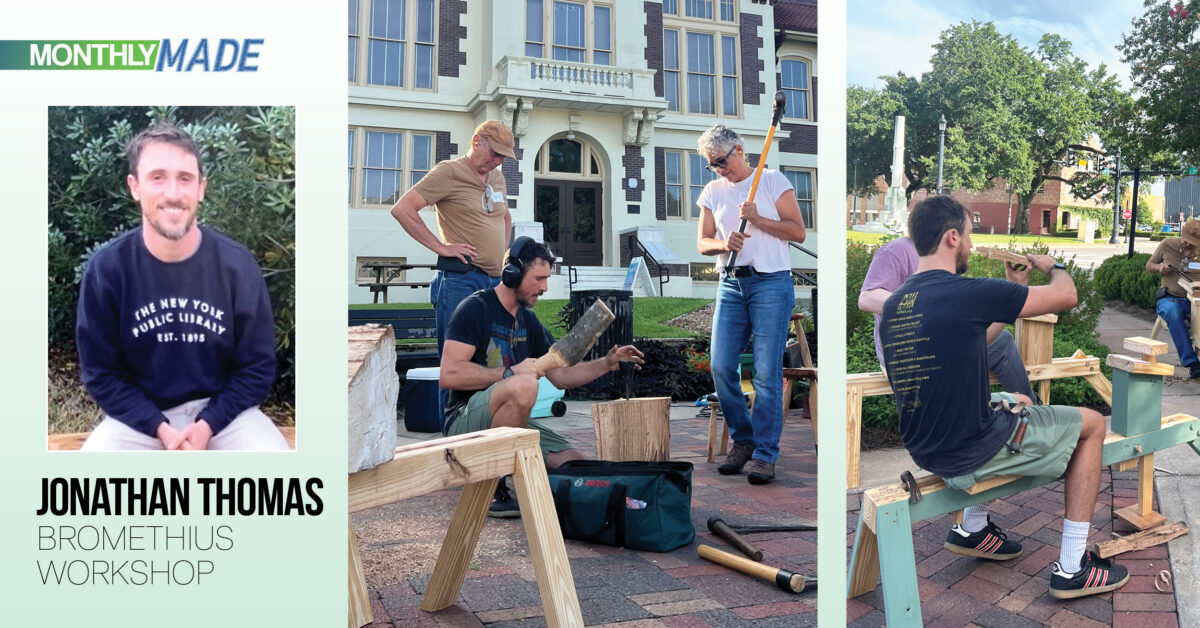
One of Four 2026 Resident Artists at the Imperial Calcasieu Museum
Before mass manufacturing, skills were traditionally passed down through apprenticeships.
Think about deeply historical jobs like blacksmithing. Those with the experience spent years teaching the younger generations how to master a complex task. These days, knowledge of traditional ways to do things is decreasing. Jonathan Thomas, self-taught woodworker, is helping share the art of stool making with the local community while running his own workshop.
What piqued your interest in woodworking and how long have you been doing it?
When I was younger, I was interested in building houses. When I got to an age when I really had the chance to dig into these ideas, I discovered that house building is not a creative process. However, I discovered chairmaking along the way. Chairs are widely regarded as the most challenging task for a wood worker. This was attractive to me. They are both decorative and durable.
Tell us about being a 2026 resident artist for the Imperial Calcasieu Museum.
The residency has been so much fun. They do a phenomenal job of documenting for socials and advertising work. They also have connected me with prospective students and commissions and given me a platform to show what I can do. The opportunity to be part of the local art community is something that I cherish.
What is the process of harvesting your own wood?
Harvesting wood is daunting. An 8-foot log can weigh thousands of pounds and it takes hours to break down. Because it is so labor intensive, I try to be very careful with my use of materials. Usually, I work with the lesser material first and save the real premier materials for special projects. This residency has turned that idea on its head. When I am working on projects for my exhibition in January, I gravitate to the very best of my wood supply first.
A few years ago, I felled and split a tree. Ironically, that log ended up being mostly useless. Beetles had gotten to it and degraded the fibers, making them brittle and poor quality for furniture. This was a hard lesson. I spent 20 hours breaking this log down, all for materials I wasn’t even able to work with. I learned how precious quality materials really are and how important it is to evaluate a tree before committing to breaking it down.
What is your creative process like when making a piece?
The task always follows three principles—is it strong, beautiful, and comfortable? I spend a lot of time reading and studying the work of other designers. One of the core ideas I wrestle with is what am I attracted to? What do I want to make?
There are days of daydreaming and sketching. When I have a clear idea of where I want to go, I sketch a model. This is a quick sketch drawn at a very small scale. I will use that sketch to play with lines and geometry. When all the parts and pieces are decided upon, I will begin the process of creating full scale plans. These plans will be fully labelled with every joint marked and every angle identified. I will use these blueprints when I begin laying out parts for the chair as a guide for construction. The plans get taped up on the wall of my shop and will be used to make any jigs and to help me stay on target once I start breaking down bulk materials.
You mention a passion for preserving the art of chairmaking. What and who are you inspired by?
Inspiration is everywhere. I see it every time I step into my garden or walk around town. I am constantly moving things around to better understand them, picking them up and setting them on edge. I think my primary inspiration comes from Hans Wegner and Dawson Moore. Wegner is the classic mid-century modernist. He is renowned for making the critical transition from rustic handmade chairs (imagine that of Appalachia) to modern design.
Moore’s work is more reliant on hand tools. If Wegner was pushing the craft away from the rustic by introducing modern tools, Moore is a course correction bringing those designs back to the realm of handwork. Moore hand finishes every surface with a knife, rather than the belt sanders of the industrial shops of PP Moller (Wegner’s manufacturers).
I work at the intersection of these styles. I try to make sure my work is elegant and strong, but I also don’t have many heavy tools and rely on bushcraft skills passed down for generations. I like to say that I use traditional techniques to achieve modern designs.